
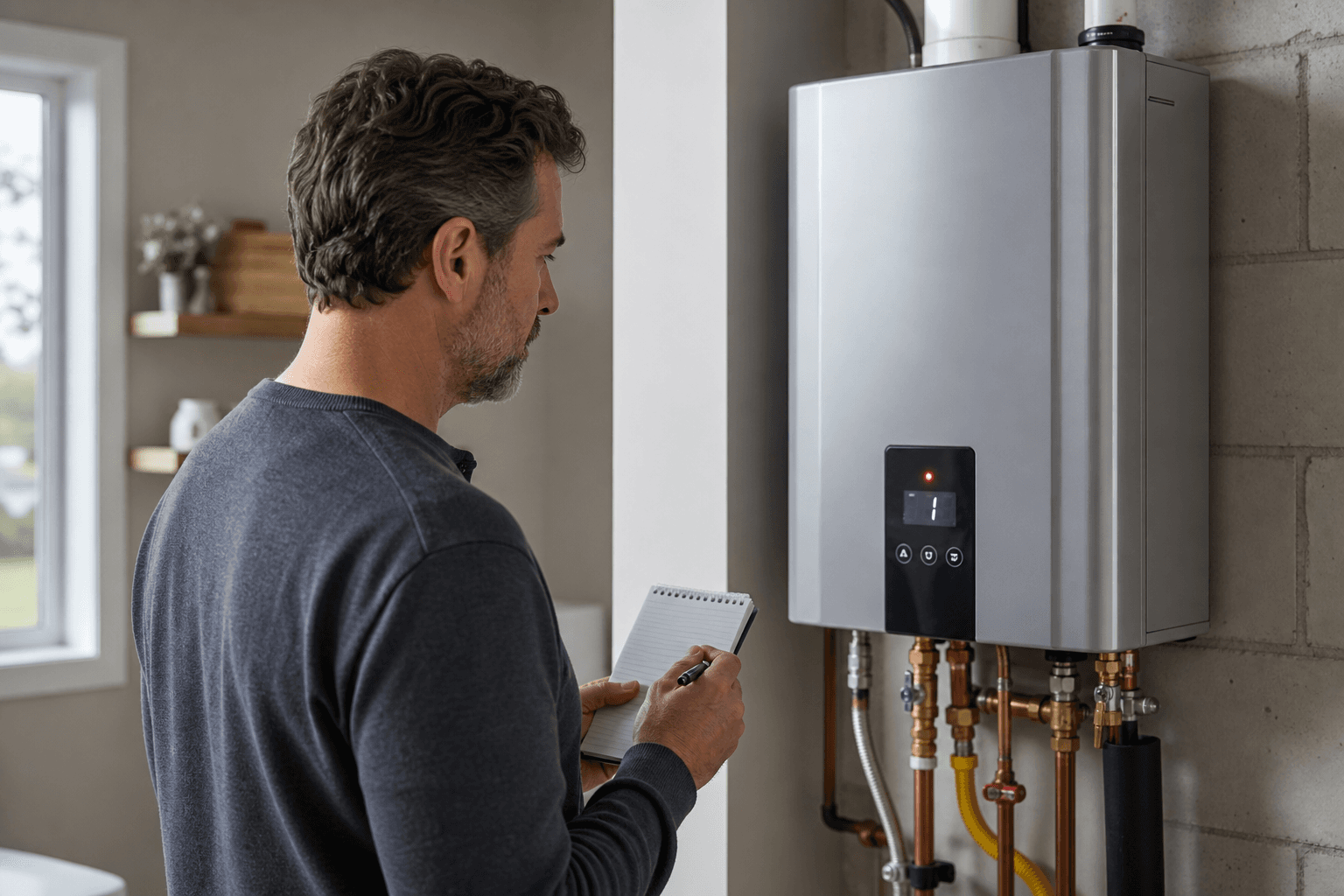
How Can You Approach Tankless Water Heater Maintenance Safely?
You can approach tankless water heater maintenance safely by starting with observation and documentation, checking the manufacturer’s instructions, and stopping before any work involving fuel, electricity, venting, valves, or internal components. Maintenance requirements vary by equipment and installation, so online instructions should not replace equipment-specific guidance or qualified service.
Quick summary

- Observe the system without removing covers or changing controls, valves, or connections.
- Record the manufacturer, model, symptoms, error messages, timing, and recent service history.
- Use the manufacturer’s instructions rather than assuming there is one maintenance schedule for every tankless water heater.
- Stop and arrange qualified help before fuel, electrical, venting, isolation-valve, internal, flushing, or descaling work.
- Ask a service provider to separate required maintenance from repairs, optional work, and replacement recommendations.
Step 1: Observe the system without opening or altering it
Begin with what you can safely see and notice from outside the unit. Do not remove covers or attempt to reach internal parts just to investigate a symptom.
Record whether the water heater is delivering hot water consistently and whether the issue affects one tap or the whole home. Also note unusual sounds, visible water, error messages, unusual odours, or changes in how quickly the system responds. Note whether the problem occurs only during heavy hot-water use or appears every time the system operates.
Stop point: If you notice a leak, unusual odour, repeated fault messages, complete loss of hot water, or another condition that appears unsafe, do not keep testing the unit. Keep clear of the equipment and arrange appropriate qualified or urgent help.
Step 2: Gather the information a technician will need

Good information can make an evaluation more focused. Before booking service, gather what is readily available without touching the equipment internally:
- the manufacturer and model, if visible from the exterior label or your records;
- any displayed error code or message, copied exactly;
- what changed and when you first noticed it;
- whether hot-water performance is reduced, intermittent, or absent;
- any visible moisture, staining, unusual sound, or odour;
- recent maintenance, repairs, installation documents, or recommendations; and
- water-quality concerns you have noticed that may be relevant to operation.
Photographs of the external label, display, and surrounding area may also help a service provider understand the situation before an appointment. Avoid taking photographs that require removing panels or entering a restricted area.
Step 3: Use the manufacturer’s instructions as the boundary
There is no single online maintenance routine that applies to every tankless water heater. Equipment design, fuel source, installation, water conditions, and manufacturer requirements can differ. Start with the owner’s manual and any installation or service documents you have.
Use those documents to identify the maintenance tasks the manufacturer describes, any warnings, and the conditions that require a qualified technician. If the instructions are missing, unclear, or do not match the equipment in your home, arrange an evaluation rather than improvising.
Be cautious with generic videos and checklists that present flushing, descaling, reset procedures, or valve operation as universal homeowner tasks. A procedure suitable for one model or installation may not suit another.
Stop point: If you cannot confirm that a task applies to your exact equipment and can be performed safely by a homeowner, leave it undone and ask a qualified service provider.
Step 4: Stop before fuel, electrical, venting, or internal work
Some parts of tankless water heater maintenance should not be improvised. Do not work on fuel or gas connections, electrical components, combustion-related areas, venting, internal parts, or isolation valves unless the equipment-specific instructions clearly permit the task and you are qualified to perform it.
Do not assume that flushing or descaling is automatically safe without preparation. These procedures can involve connections, valves, cleaning solutions, and equipment-specific steps. If you are unsure what needs to be isolated, disconnected, opened, or restored, stop before beginning.
Do not bypass a fault, alter a safety control, or continue operating equipment that appears damaged or unsafe. A professional can determine whether the issue is routine maintenance, a repair concern, an installation problem, or a condition requiring urgent attention.
Safety limit: This article helps you decide what to observe and prepare. It is not fuel, electrical, venting, combustion, valve, flushing, descaling, or internal repair instruction.
Step 5: Decide whether the next step is maintenance, repair, or evaluation
Once you have documented what you are seeing, choose the next step based on the equipment’s condition rather than on a sales recommendation alone.
| What you know | Reasonable next step |
|---|---|
| The system appears to be operating normally, and you are unsure what routine care applies. | Review the manufacturer’s instructions and arrange professional maintenance if the required work is unclear or outside your comfort level. |
| You have unusual sounds, inconsistent hot water, error messages, visible moisture, or a change in performance. | Arrange a tankless water heater evaluation before approving repairs or replacement. |
| You suspect a fuel, electrical, venting, combustion, or internal issue. | Stop investigating and seek qualified service. Do not alter the equipment to test a theory. |
| You have been told replacement is necessary but do not understand why. | Ask for the findings and documentation, then consider an independent water heater second opinion. |
SO HVAC provides tankless water heater evaluations and service using an evaluation-first approach. Its stated process is to explain what is required, what is optional, and the trade-offs among solutions in plain language. This can help you decide whether the next step is maintenance, repair, replacement guidance, or more information.
What to ask before approving tankless water heater service
A clear conversation with a service provider should leave you able to explain what was found and why the proposed work is appropriate. Ask:
- What did you observe or test?
- Is the recommendation routine maintenance, a repair, an installation correction, or replacement guidance?
- What work is required now, and what is optional or preventative?
- Which part of the manufacturer’s documentation supports the recommendation?
- What symptoms or conditions would make the recommendation more urgent?
- Can the equipment remain in service, or is there a specific reason it should not?
- If replacement is recommended, what evidence shows that repair or maintenance is not reasonable?
If you already have a quote or recommendation, an independent assessment can help you compare the explanation rather than comparing prices alone. SO HVAC also discusses the distinction between a water heater second opinion and an installer recommendation.
Finding tankless water heater maintenance in Mississauga and nearby Ontario communities
For homeowners looking for tankless water heater maintenance in Mississauga, the priority is finding a provider who can assess the specific equipment and explain the work clearly. SO HVAC is an Ontario-based residential HVAC and water systems company serving Mississauga, Oakville, Burlington, Brampton, Milton, Hamilton, Niagara, Cambridge, Guelph, and Orangeville.
Its services include tankless water heater evaluations, replacement guidance, preventative maintenance plans, and emergency support. You can review its tankless water heater service information before deciding whether to request an evaluation.
Tankless water heater maintenance safety questions
Can I perform tankless water heater maintenance myself?
You can safely begin by observing the system, recording symptoms, locating model information, and reviewing the manufacturer’s instructions. Do not assume that fuel, electrical, venting, valve, flushing, descaling, or internal work is suitable for a homeowner. If the task requires opening the equipment or you cannot confirm that it applies to your exact model, arrange qualified help.
What signs mean my tankless water heater needs professional attention?
Arrange professional attention when you notice inconsistent or absent hot water, repeated error messages, unusual sounds, visible leaks or moisture, unusual odours, or a significant change in performance. A suspected issue involving fuel, electricity, venting, combustion, internal components, or safety controls should not be investigated by trial and error.
When should I get a second opinion on recommended tankless water heater work?
Consider a second opinion when you are unsure whether replacement is necessary, the explanation is unclear, the proposed work includes required and optional items without distinction, or the recommendation does not match what you observe or what your equipment documents say. A no-obligation second opinion can give you another evaluation before you commit to major work.
Choose the safest next step for your tankless water heater
Safe tankless water heater maintenance starts with restraint: observe what you can see, document the symptoms, consult the manufacturer’s instructions, and stop before work involving fuel, electricity, venting, valves, or internal components. Professional evaluation is appropriate when the system shows active symptoms, the maintenance requirement is unclear, or repair or replacement has been recommended without a clear explanation.
SO HVAC offers free, no-obligation second opinions on HVAC and water systems, with no requirement to purchase afterward. To request an evaluation or second opinion, contact SO HVAC.