
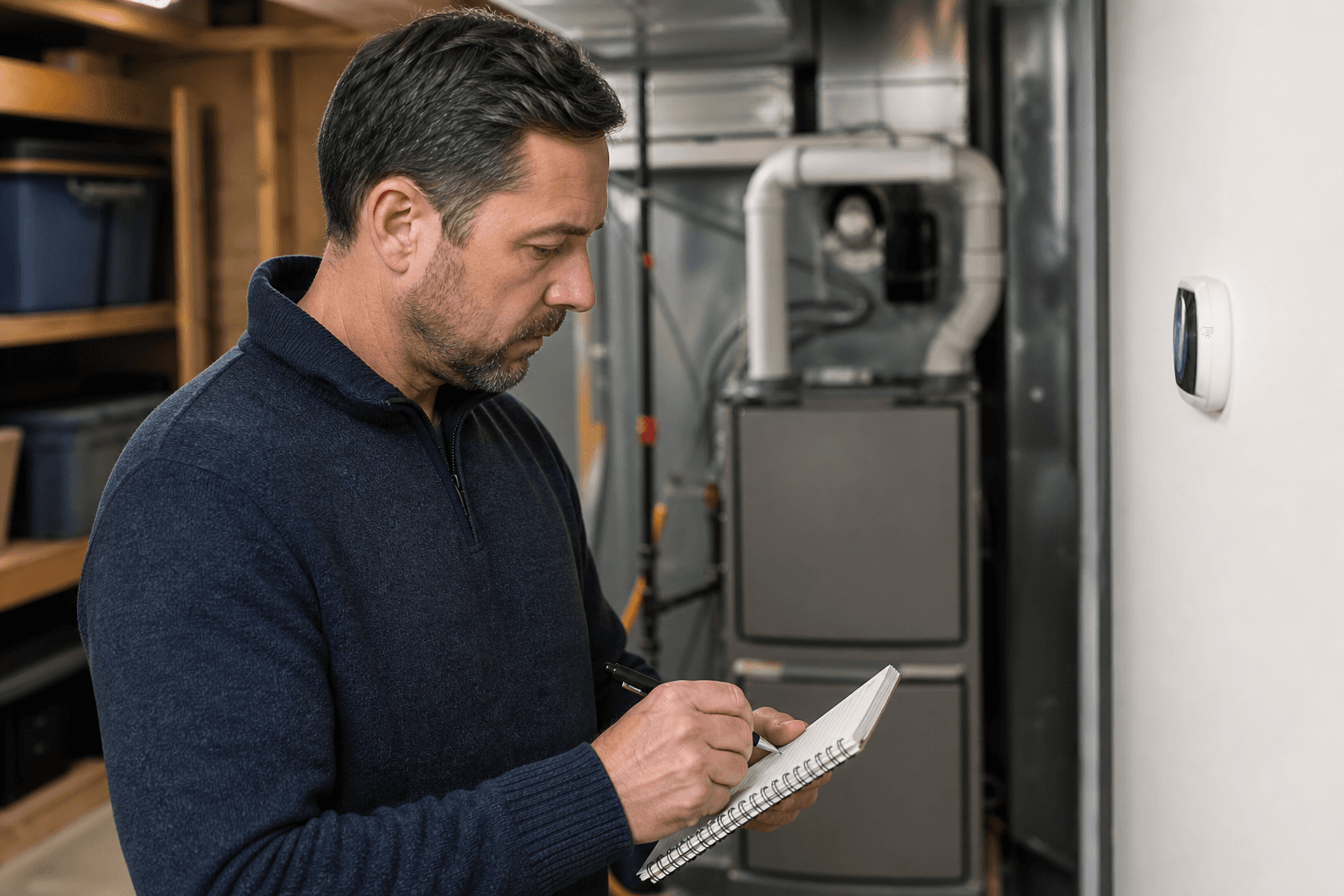
Furnace Troubleshooting Timeline for Ontario Homeowners
A furnace troubleshooting timeline is an ordered decision path, not a promise that a repair will take a particular amount of time. It helps you move from noticing a symptom to recording useful details, completing only basic observations, recognizing when to stop, and deciding whether professional service is needed.
For Ontario homeowners, the most useful approach is to describe what the furnace is doing without assuming which component has failed. Safe observations can make a service conversation clearer, but diagnosis, internal repairs, and decisions about replacement require an appropriate furnace evaluation.
Quick summary

- Start with the observable symptom, such as no heat, unusual operation, repeated shutdown, or inconsistent comfort.
- Record the thermostat display, timing, sounds, smells, recent changes, and whether the issue is intermittent or recurring.
- Limit checks to safe, visible observations and normal controls. Do not open the furnace or work on gas, combustion, electrical, or internal components.
- Stop when there may be a safety concern, the condition is worsening, or the issue requires diagnosis.
- Before accepting major repair or replacement work, ask what is required, what is optional, and what alternatives exist.
What a furnace troubleshooting timeline actually means
The word “timeline” can be misleading. In this context, it does not predict how quickly a technician will diagnose or repair a furnace. The same symptom may have more than one possible explanation, and the appropriate next step depends on the equipment and circumstances.
Instead, a troubleshooting timeline gives you a sensible sequence:
- Notice and describe the first symptom.
- Record what the furnace and thermostat are doing.
- Complete only safe, basic observations.
- Stop when the issue exceeds those observations or raises a safety concern.
- Arrange a professional evaluation when needed.
- Review whether repair, maintenance, or replacement assessment is appropriate.
This order helps prevent two common mistakes: treating a symptom as proof of a failed part, or agreeing to a major replacement before the situation has been clearly explained.
Stage one: describe the first symptom

Begin with what you can actually observe. The furnace may not appear to provide heat, may operate differently than usual, may shut down repeatedly, or may leave some areas feeling less comfortable than others.
Avoid turning the observation into a diagnosis. “The furnace is not producing the expected heat” is more useful than “the heat exchanger has failed” unless a qualified professional has established that conclusion. A single symptom can have multiple possible explanations, so describe the behaviour and leave the cause open.
Stage two: record what the furnace is doing
Before requesting service, write down details that can help someone understand the problem. Your notes do not need to be technical. Include:
- What the thermostat is set to and what appears on its display.
- Whether the system responds when the temperature setting is adjusted through normal controls.
- Whether the issue began suddenly or developed gradually.
- Whether the problem happens continuously, occasionally, or only under particular conditions.
- Any unusual sounds, smells, or visible changes.
- Recent changes to the home, thermostat, equipment, or household use.
- Any previous service recommendation, written note, or quote.
Recording these details supports clearer communication, but it does not establish which component is faulty or whether replacement is necessary.
Stage three: limit checks to safe, basic observations
Homeowners can gather information without attempting internal furnace work. Keep checks limited to what is visible and familiar, such as reading the thermostat display, noting whether the system responds to normal controls, and observing whether the reported behaviour continues.
Do not open the furnace, handle internal parts, interfere with gas or combustion components, work on electrical components, or attempt to diagnose a carbon monoxide concern yourself. If you are unsure whether a check is safe or do not understand a control, stop and request professional help.
The aim is not to force the furnace to run or prove a theory. It is to collect accurate observations while avoiding actions that could create additional risk or make the original problem harder to assess.
A furnace troubleshooting timeline at a glance
| Stage | Homeowner goal | Useful information | When to stop |
|---|---|---|---|
| Notice the symptom | Describe the observable problem | No heat, unusual operation, repeated shutdown, or inconsistent comfort | Do not assume the symptom identifies the failed component |
| Record behaviour | Capture when and how the issue occurs | Thermostat display, timing, sounds, smells, recent changes, and recurrence | Stop if the condition is worsening or concerning |
| Make basic observations | Check only visible conditions and normal controls | What responds and what does not | Do not access internal, gas, combustion, or electrical components |
| Request an assessment | Have the issue evaluated appropriately | Your notes, prior recommendations, and any quote | Move to professional help when diagnosis or repair is required |
| Review the options | Understand the recommended next step | What is required, what is optional, and the trade-offs | Pause before committing if the recommendation is unclear |
There is no universal troubleshooting duration or guaranteed repair outcome. The useful endpoint is not a fixed number of minutes; it is reaching a clear and appropriate next decision.
When to stop troubleshooting
Stop homeowner troubleshooting if you notice a possible safety concern, the condition is getting worse, the furnace repeatedly fails to operate normally, or the next step would involve unfamiliar controls, internal access, gas, combustion, electrical components, or diagnosis.
Do not continue experimenting simply because the furnace has not started working. Arrange professional or emergency support when the situation requires it. SO HVAC provides furnace and heating-system evaluations, repairs, preventative maintenance, and responsive 24/7 emergency HVAC support. For additional preparation related to an urgent situation, review this emergency HVAC response decision guide.
If you suspect immediate danger, leave the area and contact the appropriate emergency service rather than attempting to troubleshoot the equipment.
Why troubleshooting observations are not a diagnosis
Observations answer questions such as “What happened?” and “When does it happen?” A diagnosis answers a different question: “What is causing it?” The second question may require equipment-specific testing and professional assessment.
This distinction matters when someone says a furnace must be replaced based only on one symptom. A symptom may justify an evaluation, but it does not by itself confirm a failed component, establish that repair is impossible, or prove that replacement is the only option.
How the timeline leads to the next decision
Once the situation has been assessed, the next step may involve repair, preventative maintenance, or a replacement assessment:
- Repair: appropriate when the equipment can be serviced and the assessment supports fixing the problem.
- Preventative maintenance: useful when the goal is ongoing equipment care or a maintenance need has been identified.
- Replacement assessment: relevant when the condition, suitability, or future use of the existing system needs broader consideration.
The right choice should follow an assessment rather than a symptom alone. SO HVAC’s furnace repair checklist offers related preparation points. If replacement has been recommended, its furnace replacement second-opinion resource can help you frame questions.
What to prepare before requesting furnace service
Have your notes ready when you contact a professional. Include the symptom, when it began, whether it recurs, what the thermostat shows, any sounds or smells, and recent changes. If another provider has assessed the system, keep the written recommendation or quote available.
Ask:
- What has been confirmed, and what is still only a possibility?
- What work is required now?
- What is optional or preventative?
- What alternatives should be considered?
- Is the recommendation for repair, maintenance, or replacement assessment?
When an independent furnace evaluation is useful
An independent evaluation can be useful when you have received a replacement recommendation, the quote is unclear, the explanation does not match what you observed, or you want to understand the trade-offs before committing to significant work.
SO HVAC, also known as Second Opinion HVAC Services Inc., describes its approach as evaluation-first and independent of equipment sales. Its team explains in plain language what is required, what is optional, and how available solutions differ. The company offers free, no-obligation second opinions on HVAC and water systems, so homeowners can seek another perspective without treating the second opinion as a commitment to purchase.
Furnace troubleshooting timeline questions
Does a furnace troubleshooting timeline predict how long a repair will take?
No. It describes the order of decisions, not a guaranteed diagnostic or repair timeframe. The time and work involved depend on the equipment and issue identified during assessment.
What should I record before calling for furnace service?
Record the main symptom, when it began, whether it is intermittent, what appears on the thermostat, unusual sounds or smells, recent changes, and any previous recommendation or quote. Keep the description factual rather than assigning a cause.
When should I stop troubleshooting my furnace?
Stop when there may be a safety concern, the condition is worsening, the system repeatedly fails, or the next step involves internal, gas, combustion, or electrical components. Contact professional or emergency support as appropriate.
When is a furnace replacement second opinion useful?
It can be useful after a replacement recommendation, an unclear quote, or disagreement about whether repair or replacement should be considered. An independent evaluation can help separate confirmed findings from assumptions and clarify what is required versus optional.
Use the timeline to choose the right next step
A furnace troubleshooting timeline is best understood as a safe decision sequence: describe the symptom, document the behaviour, limit yourself to appropriate basic observations, and stop when the issue requires diagnosis or creates concern. This gives a professional better information without turning a homeowner observation into an unsupported diagnosis.
For Ontario homeowners, the next decision should be based on an evaluation rather than pressure or a single symptom. SO HVAC offers free, no-obligation second opinions and furnace evaluations across its service area. To discuss your situation, call SO HVAC at (825) 258-5471.