
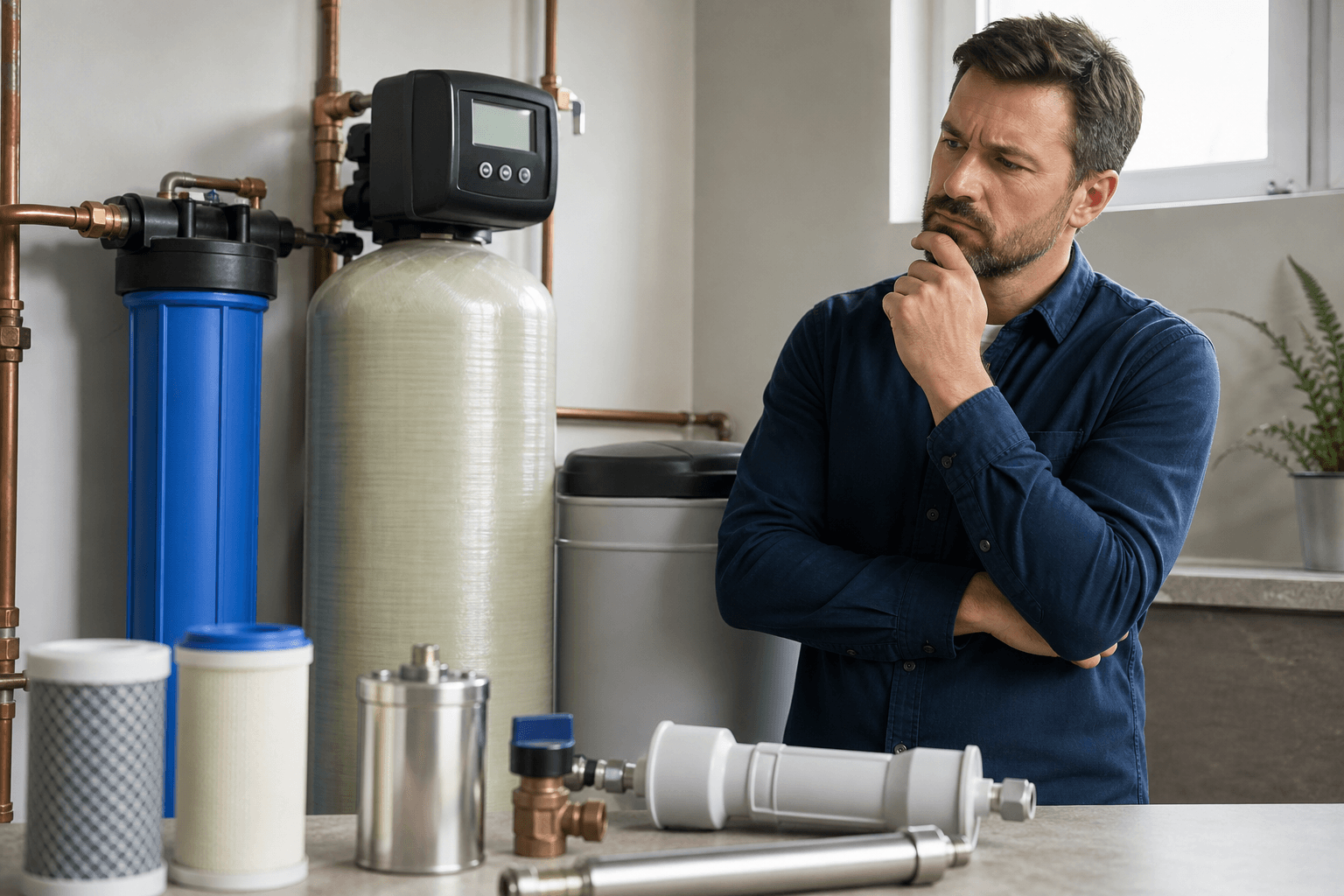

Water softener alternatives: What should you ask before you decide?
Quick decision checklist and how to use this article
If you are seeing scale in kettles, spotting on glassware, or reduced soap lather, you may be looking at water softener alternatives. Use this quick checklist to scan what matters before you call a salesperson:
- Does the product remove hardness ions or merely change their behaviour?
- Is the treatment whole-home or point-of-use?
- What independent tests or before/after hardness readings can they show?
- What maintenance and running costs are required?
- Are there local rules about brine discharge I should check?
This article explains how common alternatives actually work, the realistic outcomes to expect, exact questions to ask installers, five frequent mistakes homeowners make, and sensible next steps for Ontario homes. Where a factual claim benefits from a source, the paragraph includes the supporting link.
How alternatives differ from a traditional ion-exchange softener
A traditional ion-exchange water softener removes calcium and magnesium by swapping them for sodium or potassium ions, producing the familiar "soft" feel and preventing scale formation inside water heaters and plumbing. Many alternatives do not remove hardness ions. Instead they change mineral behaviour or treat limited volumes of water, so the results and benefits are different. For an accessible comparison of how alternatives measure up to ion-exchange systems, see a practitioner summary of options and limits from Weilhammer Plumbing and a manufacturer overview from Culligan (Weilhammer Plumbing, Culligan).
Common alternatives and exactly what each one actually does

Below are widely offered options with a plain-language summary of what each accomplishes and the realistic expectations you should hold.
Salt-free (TAC / NAC) conditioners: what they change and what they do not
Salt-free conditioners labelled Template Assisted Crystallization (TAC) or Nucleation Assisted Crystallization (NAC) alter the way hardness minerals precipitate so calcium and magnesium are less likely to stick as hard scale on surfaces. They do not remove the ions from water, so water will not feel soft in the ion-exchange sense and soap performance may still be reduced. TAC systems can help reduce scale buildup on plumbing and appliances for some homes, but they are not a full replacement for an ion-exchange softener when true soft water is the goal. See Weilhammer and Culligan for the technical limits and comparisons (Weilhammer Plumbing, Culligan).
Reverse osmosis: point-of-use drinking water, not a whole-home softener
Reverse osmosis (RO) systems are very effective for producing low-mineral drinking and cooking water at a single tap. RO is commonly installed under a kitchen sink and is not a substitute for whole-home softening because it treats a small volume rather than all household water. If your main concern is taste, drinking-water scale on kettles, or mineral content in beverages, RO is appropriate; it does not prevent scale throughout plumbing or protect a central water heater in the same way a whole-home softener would (WatersoftenerMississauga).
Polyphosphate dosing and sequestrants: short-term scale control and limits
Polyphosphate systems add small amounts of food-grade phosphate to water to sequester minerals and delay scale formation. They can protect delicate components and reduce visible scale for moderately hard water, but effectiveness declines with very hard water and the chemical must be replenished. These systems are often best where hardness is borderline or where a homeowner wants minimal plumbing changes.
Magnetic and electronic conditioners: the evidence and buyer beware points
Magnetic, electronic, or electromagnetic scale controllers claim to alter crystal formation through fields rather than chemicals. Evidence is mixed, and independent, repeatable testing is rare. When you encounter these products, ask for documented, independent test data that shows before-and-after hardness or measured scale reduction in systems comparable to your home. Weilhammer’s overview stresses buyer caution and evidence-based evaluation for these technologies (Weilhammer Plumbing).
Decision checks: precise questions to ask before you commit
Each of the checks below is a standalone question to ask any installer, along with the evidence to request and what outcome to expect.
Does the system actually remove hardness ions or just change their behaviour?
Why ask: ion removal is the only way to produce true soft water that improves soap lather and prevents mineral deposits in appliances. What to request: a lab water test or before-and-after hardness readings reported in grains per gallon or ppm. Realistic outcome: if the installer cannot show ion-removal data, expect conditioning rather than soft water.
Is the solution whole-home or point-of-use, and which do you need?
Why ask: whole-home treatment protects plumbing, water heaters, laundry, and showering; point-of-use protects only a specific tap. What to request: a written recommendation that explains which fixtures the installer intends to protect. Realistic outcome: point-of-use RO makes drinking water excellent, but it will not stop scale in pipes or the water heater.
What proof should they show: tests, warranties, and maintenance plans?
Why ask: alternatives can require ongoing maintenance or produce variable results. What to request: manufacturer data sheets, independent test reports, a clear maintenance schedule, sample warranty terms, and an explanation of parts and service responsibilities. Realistic outcome: a reputable provider will provide documentation and a reasonable maintenance plan; limited or verbal-only promises are a warning sign. Culligan’s overview lists maintenance and product differences to consider when comparing options (Culligan).
How will the system affect soap use, laundry, and water-feel expectations?
Why ask: many homeowners expect a 'soft' feel immediately. What to request: a frank description of how laundry, dishes, and skin contact are likely to change and whether any detergents should be adjusted. Realistic outcome: TAC or sequestrants may reduce scale but not recreate the silky feeling of ion-exchange softened water.
Are there municipal rules about brine discharge or installation I should know?
Why ask: salt-based softeners regenerate by producing brine that may be regulated by local sewer or conservation authorities. What to request: guidance on local disposal rules and a suggestion to check with your municipal public works. Realistic outcome: some municipalities impose limits or require permits; installers should advise you to contact local authorities if you are unsure.
Local considerations for Mississauga and Ontario homeowners
Water hardness varies across Ontario and even between neighbouring suburbs. Before choosing a path, test your water or ask a qualified technician to do so. Local resources and local installers can help interpret results. For Ontario homeowners who want an independent evaluation without sales pressure, SO HVAC evaluates water softener options, reverse osmosis systems, and related recommendations as part of a no-obligation second opinion in Mississauga and surrounding areas; their approach centres on an honest assessment and plain-language guidance (SO HVAC). For context on whether a whole-home softener is commonly necessary in Mississauga, a local practitioner discussion explains when RO or conditioners may be enough versus when a softener is the direct solution (WatersoftenerMississauga).
Five common mistakes homeowners make when choosing an alternative

-
Believing "salt-free" means "soft".
Why it happens: marketing language. How to avoid it: insist on hard numbers or a demonstration of before/after hardness readings.
-
Not testing your water before buying.
Why it happens: installers sometimes depend on visual clues. How to avoid it: request a lab or calibrated field hardness test and keep the results for comparison.
-
Choosing point-of-use when you need whole-home protection.
Why it happens: RO systems are attractive but limited. How to avoid it: map where scale and performance problems occur in your home, then match the solution to the problem.
-
Accepting vague performance claims without documentation.
Why it happens: installers rely on anecdotes. How to avoid it: ask for manufacturer data sheets and independent tests and walk away if none are provided.
-
Overlooking ongoing costs and maintenance.
Why it happens: low upfront price appears attractive. How to avoid it: get a one-year and three-year maintenance cost estimate and include filter, chemical, and service expenses in your decision.
When combinations make sense: pairing alternatives with point-of-use filters
Sometimes a hybrid approach is the most practical: a salt-free TAC conditioner at the main line to reduce scale on plumbing, coupled with a reverse osmosis system at the kitchen tap for drinking water. That pairing can reduce visible scale while still offering high-quality drinking water. Expect conditioned water but not ion-free water except at the RO tap. Combining treatments should be planned so components do not interfere with each other, and a qualified technician can confirm compatibility and expected maintenance.
Next steps: how to confirm whether an alternative will work for your home
Follow these practical steps:
- Order a water hardness test or ask an installer to perform one and provide the result in writing.
- Match symptoms to scope: where is scale showing, and which fixtures are affected?
- Ask each provider the decision-check questions above and request documented proof and a maintenance plan.
- If anything feels unclear or sales-driven, book an independent second opinion before committing. SO HVAC offers evaluation-first, no-pressure second opinions for Ontario homeowners that explain required versus optional measures in plain language (SO HVAC).
Frequently asked questions
Do salt-free water conditioners make your water feel soft?
No. Salt-free conditioners change how calcium and magnesium crystallize so they are less likely to adhere as hard scale, but they do not remove the ions that make water "hard." Expect less scale in some systems, but not the silky feeling or soap performance of ion-exchange softened water. See Weilhammer and Culligan for comparisons and limitations (Weilhammer Plumbing, Culligan).
Can reverse osmosis replace a whole-home water softener?
Not usually. Reverse osmosis is a point-of-use solution designed for drinking and cooking water. It does not treat the entire house, so it will not prevent scale inside water heaters or across plumbing the way a whole-home softener does (WatersoftenerMississauga).
How do I check whether my water needs whole-home treatment or point-of-use filtration?
Start with a calibrated hardness test and a short audit of where you see scale, soap performance issues, or appliance problems. If scale appears throughout plumbing and appliances, whole-home treatment is usually the right category. If the issue is only drinking water taste or kettle scaling, a point-of-use RO may suffice.
Are there rules in Mississauga about brine discharge from salt-based softeners?
Municipal rules can vary. Ask your installer to advise and contact Mississauga public works or the local conservation authority if you need definitive guidance. Installers who understand local requirements should be willing to help you confirm disposal rules for brine.
Is SO HVAC’s free second opinion really free and what does it cover?
SO HVAC offers a free, no-obligation second opinion that evaluates HVAC and water systems, explains what is required versus optional, and provides plain-language advice without sales pressure. For more about their evaluation-first approach and service area, see SO HVAC’s website (SO HVAC).
Independent second opinions: what to expect and a no-pressure next step
If you have a quote or a recommendation and anything about it feels unclear, a free, independent second opinion can save time and money by confirming whether a full softener, a conditioning alternative, or a point-of-use solution is the right fit. SO HVAC’s evaluation-first model focuses on explaining the trade-offs in plain language so you can decide without pressure. To learn more or to book an assessment in Mississauga and surrounding Ontario areas, visit SO HVAC. Ready to get a no-pressure second opinion?