
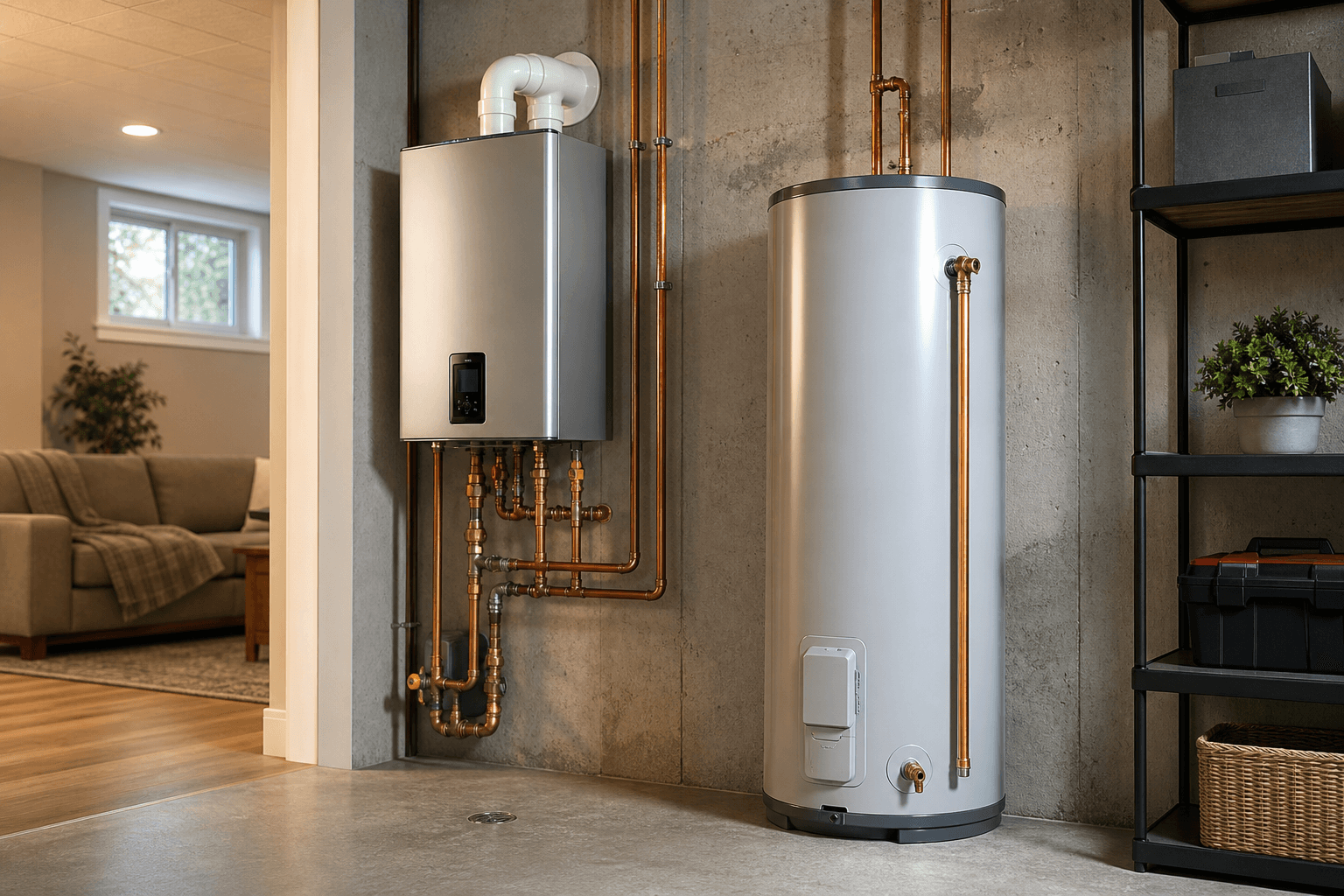

Tankless vs tank comparison: which fits your Ontario home?
Quick self-classifier: which household pattern are you?
Before you read the full comparison, use this short checklist to identify your primary hot-water pattern. Circle the one that matches your home most days and follow the related sections below.
- Surge mornings: two or more simultaneous showers, plus dishwasher or laundry during the morning. If yes, you are surge-heavy.
- Steady spread-out use: showers, dishwasher, and laundry are staggered across the day. If yes, you have spread-out demand.
- Small household or single occupant: low total daily use, occasional visitors. If yes, you are low-demand.
- Planning to stay long term and willing to upgrade infrastructure: ready for higher upfront cost for longer life and lower operating losses. If yes, you are long-term upgrade focused.
- Constrained by existing infrastructure: limited gas-line size, difficult venting route, or limited electrical capacity. If yes, you may prefer the lower-disruption option.
How tank and tankless systems differ in principle
The core difference is simple and explains most trade-offs. A conventional tank water heater stores a finite volume of hot water, so it acts like a battery of ready hot water that can handle simultaneous draws but can run out if several fixtures run at once. The tank model gives strong short-term flow at once, but it has standby heat losses from stored water over time. This explanation matches practical summaries used by installers and technical guides HotWaterAtlas and Ecofrost Heating.
A tankless water heater heats water on demand as it flows through the unit, so you get effectively unlimited hot water for long showers, but the device is limited by a maximum flow rate. In practical terms, a tankless can cap how many fixtures can run together before output temperature drops. The trade-off is capacity versus continuity, which many Ontario installers emphasise HotWaterAtlas and Tornado Plumbing.
Decision criteria to compare both options
When assessing a tankless vs tank comparison, use the same set of criteria for both quotes. That keeps decisions objective and comparable.
- Capacity and simultaneous use, measured in litres or number of concurrent fixtures.
- Continuous flow limits, measured in litres per minute at a target temperature rise.
- Installation disruption and upgrade needs, including gas-line size, venting route, and electrical service.
- Lifespan and maintenance expectations, including descaling or sacrificial anode needs.
- Operating losses and efficiency, meaning standby losses for tanks and thermal efficiency for tankless condensing models.
- Short-term cost and long-term ownership considerations, based on how long you plan to remain in the home.
What each criterion means and what to measure

Capacity and simultaneous use
Measure how many fixtures run at once during peak times. A 50 litre tank provides a burst of hot water, so two simultaneous showers plus a dishwasher may deplete it. Tankless units do not store water, so they do not run out, but they may not be able to sustain more than one or two hot showers at the same time depending on their flow rating. Guides that explain this battery versus flow behaviour are useful when you map your household profile HotWaterAtlas.
Continuous flow limits and sizing
Ask a contractor for the unit flow rating in litres per minute at the temperature rise you need. Tankless units are sized by required flow and temperature rise. If your morning routine demands a combined flow above the unit rating, you will either need a larger single unit or multiple units in parallel, which increases complexity. Local installers stress that household demand determines correct sizing, not marketing claims Tornado Plumbing.
Installation disruption and upgrades
Check existing gas-line capacity, possible venting routes, and available space. Many tankless installations in Ontario require a larger gas feed or new venting, particularly for condensing models that prefer PVC venting to the outside. If your home is constrained, the tank option often wins because it usually fits existing connections with less disruption. Ontario comparisons highlight this as a common deciding factor Universal Air Systems and Tornado Plumbing.
Lifespan and maintenance
Tankless units typically have longer useful lives when maintained properly, commonly lasting into the 15 to 20 year range, while storage tanks often last around 8 to 12 years depending on water quality and anode maintenance. Tankless units need periodic descaling in hard-water areas, and tanks need anode replacement and flushing. For Ontario homes with hard water, factor in maintenance frequency when comparing long-term ownership Get a Better Quote and Ecofrost Heating.
Operating losses and efficiency
Tanks have standby heat loss from stored water, which increases fuel use over time. Tankless units avoid standby losses because they heat on demand, which can reduce operating losses for households that use hot water intermittently. That said, the real payback depends on fuel and electricity rates, plus how much you use hot water. Ontario-focused cost analyses recommend running the exact household numbers before assuming automatic savings from tankless systems Tornado Plumbing and Imperial Heating.
Which option fits common Ontario household profiles
- Surge-heavy mornings: Families with back-to-back showers, laundry, and dishwasher in a short window often do better with a properly sized tank because a tank supplies strong simultaneous flow without the need for multiple tankless units. See the capacity discussion at HotWaterAtlas HotWaterAtlas.
- Steady spread-out use: Homes where showers and appliances are staggered through the day often benefit from tankless units, because they deliver continuous hot water and reduce standby losses when sizing and installation constraints are manageable Get a Better Quote.
- Small or occasional use: Single occupants or low-use vacation properties can favour tankless units for space savings and lower standby waste, if the initial install is feasible.
- Short-term owners or tight budgets: If you plan to move in a few years or are avoiding major infrastructure upgrades, a conventional tank often wins because it usually needs less immediate work to install and repairs cost less up front Universal Air Systems.
- Hard water areas: Both systems require attention, but tankless units can need more frequent descaling. Factor local water quality into maintenance plans and costs Ecofrost Heating.
Installation constraints every Ontario homeowner should check
These site checks commonly determine the practical choice. If a constraint exists, list it in writing for any quote you receive.
- Gas-line size and pressure, and whether an upgrade is required for a high-output tankless unit. Local plumbers and installers routinely measure this before quoting Tornado Plumbing.
- Venting route and termination for combustion air, especially for gas models and condensing tankless units.
- Electrical supply if you are considering electric tankless or pump-assisted condensing models.
- Basement layout and distance to the furthest hot-water fixture, which affects pipe lagging, recovery time, and whether a tank can be located to reduce distribution losses.
- Water hardness, because descaling frequency or anode changes will affect maintenance plans for both tank and tankless systems Get a Better Quote.
Contractor question template
- What flow rate in litres per minute will this unit supply at a 35 degree Celsius rise, and will that cover two showers plus a dishwasher?
- Do you expect a gas-line or venting upgrade? If so, what changes and who performs them?
- What maintenance will be required and how often, given our local water hardness?
- What is the manufacturer expected life, and what parts or labour warranties apply?
- Can you show sizing calculations and the assumptions used to compare a tank and a tankless option for my home?
Real objections and honest trade-offs to expect

Do not expect a universal answer. In Ontario the installation details and household pattern usually decide the choice. Tankless is not automatically cheaper to own, and tanks are not always the lower-value option. Several Ontario guides note that payback depends on site specifics and usage, so run the numbers for your home rather than relying on general claims Tornado Plumbing and Universal Air Systems.
Decision walk-through: a short example using the criteria
Walk through this anonymized scenario to see the practical steps a second-opinion evaluator follows. First, record peak simultaneous fixtures and typical draw sizes. Second, the evaluator checks gas-line diameter and measures the venting path. Third, they calculate the flow and temperature rise needed. If the flow requirement exceeds a single tankless rating and the house does not accept a second unit easily, a tank may be recommended even if the owner values long life. This process matches the evaluation-first approach used by independent advisors in Ontario Get a Better Quote and service firms such as SO HVAC.
Final decision checklist and when to get a free second opinion
Before you accept any replacement quote, complete this checklist:
- Document peak simultaneous hot-water needs and typical daily use.
- Ask the contractor for flow-rate calculations and assumptions for both options.
- Confirm whether gas-line, venting, or electrical upgrades are required and get upgrade quotes separately.
- Compare expected service schedules and the impact of local water hardness on maintenance.
- Decide if you plan to stay in the home long enough to value a longer-lived unit that has higher upfront cost.
Want an independent, no-pressure review that verifies sizing, infrastructure constraints, and honest trade-offs? Book a free second opinion with SO HVAC to compare options and confirm installation needs?
Frequently asked questions
How do I know whether my hot-water pattern is surge-heavy or spread-out?
Track a typical day for a week. Note the times when showers, laundry, and dishwashing run at the same time. If two or more fixtures commonly run together during peak windows, you are surge-heavy and should prioritise capacity. If uses are spaced apart, a tankless solution may be appropriate.
Will a tankless water heater run out of hot water during simultaneous use?
No, tankless units do not run out of stored hot water, but they do have a capped flow rate. If your simultaneous demand exceeds that flow rate, you will experience temperature drop or reduced flow. Sizing by a qualified installer will indicate whether one unit, multiple units, or a tank is the right fit HotWaterAtlas.
What site checks make a tankless installation more complicated in Ontario?
Common constraints include insufficient gas-line capacity, limited venting routes, and electrical requirements for certain models. Condensing tankless units may also need different venting materials. Have the installer evaluate gas pressure, venting path, and electrical supply before committing Tornado Plumbing.
How do maintenance needs and expected lifetimes compare between tank and tankless?
Tankless units often last longer, commonly into the 15 to 20 year range with proper maintenance, while tank water heaters commonly last around 8 to 12 years depending on water quality and how often the anode is replaced. Both systems need preventive care in hard-water areas Get a Better Quote and Ecofrost Heating.
What should I ask a contractor before accepting a water heater replacement quote?
Ask for the unit flow rating at your desired temperature rise, written sizing calculations, whether gas-line or venting upgrades are required, an itemised upgrade cost, maintenance expectations given local water hardness, and warranty details. If you want a neutral second opinion that compares the options side by side without sales pressure, book a free evaluation from SO HVAC.