
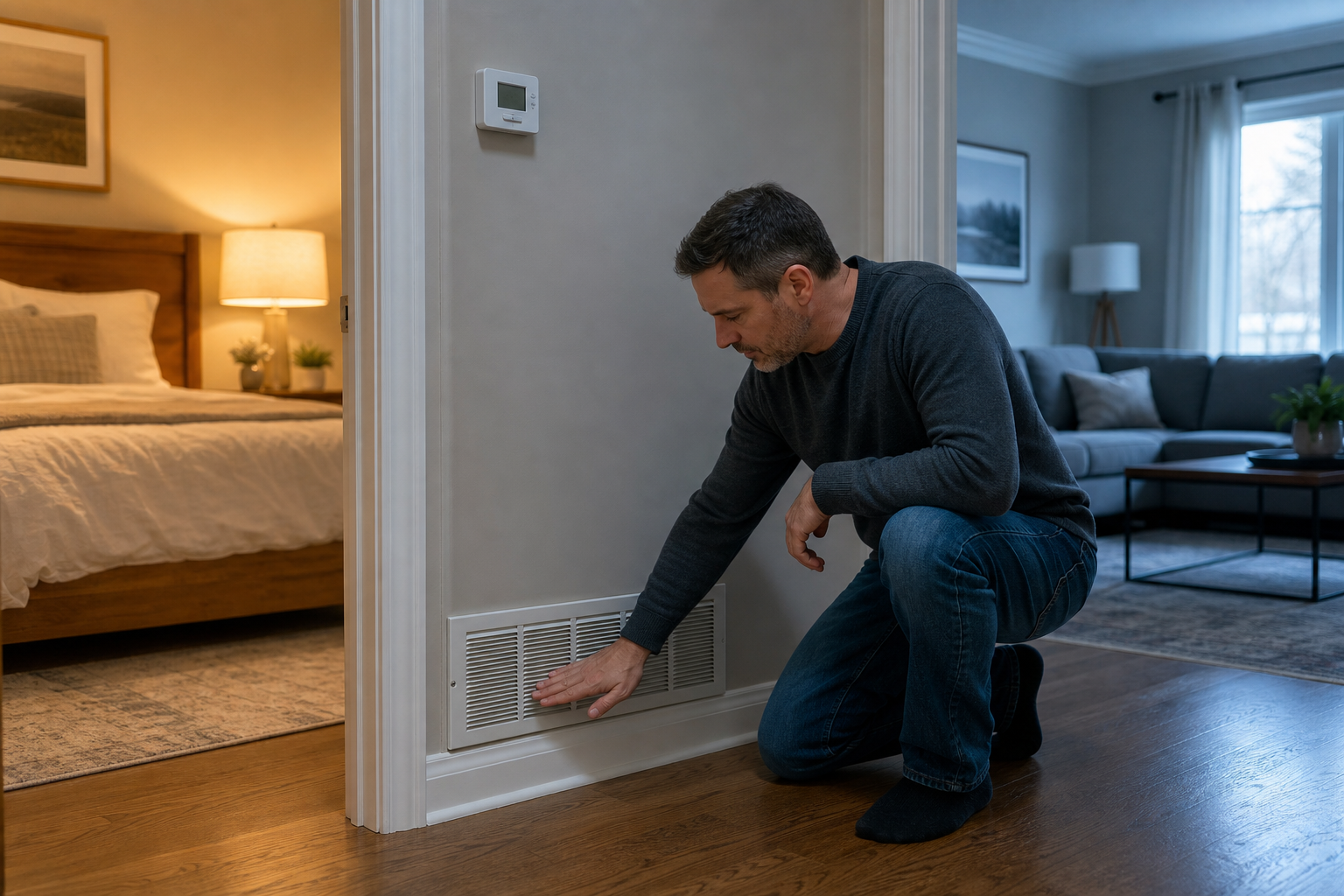
Ductwork Balancing Guide: How Ontario Homes Distribute Air
Ductwork balancing is the process of assessing and adjusting airflow distribution so rooms receive the intended amount of conditioned air. If one room is consistently too warm, another feels too cool, or some registers have weak airflow while others feel unusually strong, the issue may relate to how air is moving through the duct system.
That does not automatically mean your furnace, air conditioner, or heat pump needs replacement. Balancing is one possible part of a broader HVAC evaluation. Understanding the difference between airflow distribution, duct leakage, equipment sizing, thermostat problems, and mechanical faults can help you avoid approving major work before the actual cause is clear.
Quick summary

- Ductwork balancing focuses on how conditioned air is distributed from HVAC equipment to different rooms.
- Possible clues include uneven room temperatures, weak airflow at some registers, excessive airflow at others, and frequent thermostat adjustments.
- Balancing does not, by itself, correct duct leaks, incorrectly sized equipment, faulty components, or thermostat problems.
- Record where and when the problem occurs, then request an HVAC evaluation if the right remedy is uncertain.
What is ductwork balancing?
A duct system carries heated or cooled air from your HVAC equipment to supply registers throughout the home. Ductwork balancing looks at whether that air is being distributed appropriately between spaces. Where necessary, the system may be adjusted so the airflow pattern better matches the home and how its rooms are used.
The focus is different from simply checking whether the furnace or air conditioner turns on. An HVAC system can operate while air distribution remains inconsistent from room to room. A balancing concern is about the path and delivery of conditioned air, not just whether the equipment produces it.
Why balanced airflow matters for home comfort

Most homeowners experience an airflow problem as a comfort problem. You may adjust the thermostat because a bedroom is uncomfortable, only to make another part of the house feel too warm or too cool. You may close or open registers repeatedly, use portable fans, or avoid certain rooms during particular seasons.
These workarounds can hide the underlying issue without explaining it. Changing the thermostat affects the whole home even when only one area is uncomfortable. Identifying whether the concern is distribution, leakage, equipment operation, or another issue gives you a more useful starting point than treating every hot or cold room as proof of equipment failure.
Signs your home may have an airflow imbalance
These observations do not confirm that balancing is required, but they are useful reasons to investigate:
- Uneven room temperatures: One room remains noticeably warmer or cooler than nearby spaces during heating or cooling.
- Weak airflow: Air movement feels limited at some registers while the system is running.
- Unusually strong airflow: Some registers seem to receive much more air than others.
- Seasonal changes: A room may be difficult to heat in winter and difficult to cool in summer.
- Repeated thermostat adjustments: Household members keep changing the setting to stay comfortable.
- Persistent complaints after work: The concern began after HVAC work, a renovation, or another change to the home.
Note whether doors are open or closed, whether the issue occurs during heating or cooling, and whether it affects one room or several. These details can help distinguish a distribution concern from another cause.
What ductwork balancing does not fix by itself
Ductwork balancing is not the same as every other type of HVAC work. Adjusting airflow distribution will not automatically:
- seal gaps or leaks in ductwork;
- clean dust or debris from ducts;
- repair a malfunctioning furnace, air conditioner, or heat pump;
- correct a faulty or poorly positioned thermostat;
- make incorrectly sized HVAC equipment the right size; or
- replace worn or failed components.
More than one issue can exist at the same time. Uneven airflow may occur alongside duct leakage or an equipment problem, so a symptom should not be treated as a diagnosis.
Balancing, sealing, sizing, or repair: how to think about the difference
| Possible focus | Question it addresses | What it does not establish alone |
|---|---|---|
| Ductwork balancing | Is conditioned air distributed appropriately between rooms? | That ducts are leak-free or equipment is correctly sized. |
| Duct sealing | Is air escaping through gaps or poorly sealed connections? | That airflow will be balanced after leaks are addressed. |
| Equipment sizing | Is the heating or cooling equipment appropriate for the home? | That ducts or registers are distributing air properly. |
| Repair | Is a component or piece of equipment malfunctioning? | That a failed part is the only cause of discomfort. |
| Maintenance | Does the system need routine care? | That maintenance alone will resolve a distribution issue. |
This comparison organizes the conversation rather than replacing an assessment. The appropriate response may involve one focus or several.
Which type of HVAC attention might be appropriate?
- Ask about balancing when some rooms receive too little or too much conditioned air compared with others.
- Ask about sealing when air may be escaping from duct connections or the proposed work involves leakage.
- Ask about repair when equipment is not operating normally or a component appears to be malfunctioning.
- Ask about maintenance when you want ongoing system care rather than an explanation for a new comfort complaint.
- Request a broader HVAC evaluation when the cause is unclear, symptoms overlap, or major replacement has been recommended without clear alternatives.
For independent HVAC advice before committing to major work, SO HVAC provides evaluations and free, no-obligation second opinions on residential heating, cooling, and water systems. Its evaluation-first approach explains what is required, what is optional, and what trade-offs should be considered.
What to record before requesting an evaluation
- Affected rooms: List spaces that feel too hot, too cold, or different from the rest of the home.
- Timing: Note whether the issue occurs during heating, cooling, particular times of day, or certain seasons.
- Thermostat details: Record usual settings and how often you adjust them.
- Register observations: Note registers that seem weak, strong, noisy, or different.
- Recent work: Include repairs, replacements, renovations, or duct modifications.
- Equipment information: If available, record the make, model, age, and service history.
- Existing recommendations: Keep quotes, inspection notes, or written recommendations for discussion.
You do not need to diagnose the problem yourself. These notes simply describe your experience accurately and make it easier to compare the proposed remedy with the concern you actually have.
Does uneven airflow mean you need new HVAC equipment?
No. Uneven airflow is a reason to investigate, not proof that replacement is necessary. The concern may involve distribution, duct condition, equipment operation, sizing, thermostat behaviour, or several factors.
Replacement may be appropriate in some situations, but that decision should follow an explanation of what is wrong, what alternatives exist, and which work is genuinely required. An independent assessment can be useful when you have received a recommendation to replace a furnace, air conditioner, or heat pump and are unsure whether it addresses the actual airflow problem.
Considerations for Ontario homeowners
Ontario homes need heating and cooling across changing seasons, so an airflow concern may not look the same throughout the year. A room that feels acceptable in one season may become uncomfortable in another. Explain both the heating and cooling experience when you notice a seasonal pattern.
Consider the whole home rather than one register in isolation. Room changes, renovations, equipment work, and how household members use different spaces can all provide relevant context.
Frequently asked questions
Can ductwork balancing fix a room that is always too hot or too cold?
It may help if the main problem is uneven distribution, but the symptom alone does not confirm that balancing is the answer. Duct leaks, equipment sizing, thermostat issues, or a mechanical fault may also be involved.
Is ductwork balancing the same as duct sealing?
No. Balancing concerns how air is distributed between rooms. Sealing concerns air escaping through gaps or connections. A home may need one, the other, or further assessment.
Should I get an HVAC evaluation before agreeing to equipment replacement?
If the reason for replacement is unclear, an evaluation can help you understand the decision. Ask what is required, what is optional, and how the proposed work addresses the symptoms you observed.
Conclusion: start with the airflow problem, not automatic replacement
Ductwork balancing focuses on the distribution of conditioned air through your home. Uneven temperatures, weak airflow, strong airflow elsewhere, and repeated thermostat adjustments justify a closer look, but they do not identify the cause by themselves.
Record where and when the problem occurs, then ask whether the concern points to balancing, duct sealing, equipment sizing, repair, maintenance, thermostat attention, or a broader HVAC evaluation.
To discuss an HVAC or water-system concern without a purchase obligation, book a free, no-obligation second opinion with SO HVAC. SO HVAC provides independent, plain-language guidance with no requirement to purchase follow-on services.